By Lauren Besner
I was first introduced to Peter Liljedahl’s concept of vertical learning while in the role of an integration aide in educator Brenna Macbeth’s grade 4 math classroom. I was completely taken aback by the impact of the strategy, as I watched students productively engage in a form of group work that encouraged deeper thinking and also allowed educators to provide immediate feedback on their work. Brenna, who has integrated this technique into her pedagogy, presented me with Liljedhal’s book, Building Thinking Classrooms in Mathematics. Although originally designed and imagined to be used within the mathematics discipline, its promise of valuable outcomes had me interested in finding ways to incorporate the technique into ELA classrooms.
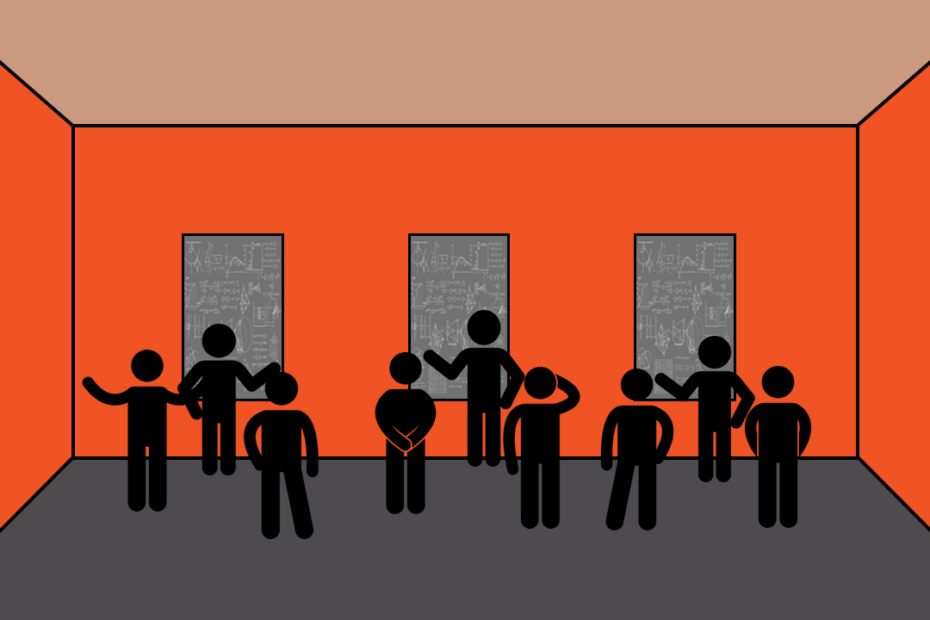
Vertical learning is a fun and interactive approach to collaborative learning. It utilizes a classroom’s non-permanent vertical writing surfaces, such as chalkboards, whiteboards or chart paper, to have students work together on a single large surface.
Seems simple enough, right? Well, according to Liljedhal, there are a few important steps which need to be followed to ensure success while using this technique. Some of his “rules” include: all vertical writing surfaces must be erasable, which allows students to correct any mistakes as they go; Students should be formed into randomized groups of three and share only one writing utensil per group; The surfaces should be set up in a space where students are unable to sit, unless, of course, there are accommodations for students with physical limitations; And lastly, all students should be working on an open-ended task that encourages critical thinking and discussion. Collectively, these will set students up for higher engagement and participation, contributing to each individual’s success in group work.
The value to be derived from this learning style benefits all students, but piqued my interest due to the manner it provides support for diverse learners. The increased engagement and deeper understanding of topics can help create a strong sense of community within the classroom. This environment and organization of group work sets up a space where each student may participate in some way. With ELA-focused tasks, students can be assigned different roles that play into their individual strengths. This activity, where peers are each being supported by each other, reaps benefits for each and every student.
There is endless opportunity for imaginative and diverse activities that can be created in an ELA classroom using this strategy. My current role heavily centers supporting students with diverse learning needs, and consequently my approach to creating vertical learning tasks takes traditional ELA schemas, and reshapes them into team learning experiences which promote inclusive and dynamic learning. The following paragraphs explore a number of activities which bring vertical learning to an ELA setting.

Character map/analysis
As the title implies, this activity uses the technique of vertical learning to analyze a character and their development throughout a story. Students may draw the character as they imagine and, depending on grade level, work to pull quotes and use evidence for their choices. If focusing on character development, it is also possible to have students identify which key events have led to the character’s transformation.
Theme Exploration
Similar to the character map, students will collaborate to find the central theme in a text. Quotes and in-text examples will be pulled and used to support their ideas.
Literary Device Exploration
This activity is used to analyze the literary devices within a given text. Each group may examine a different literary device and will identify where the device is found and how it might contribute to the overall meaning of the text.
Above are just a few examples which take commonly assigned work and transform it into a collaborative learning activity. But the vertical spaces can be used for more than group work, they also create opportunities for whole-class sharing and discussion. As a class, you may go on “class field trips”, where you walk around and explore what is written on each board. Alternatively, groups can rotate between boards throughout the work period to build on each other’s ideas. This movement based format encourages full-class engagement and allows students to narrow in on ideas.
The traditional activities that we know have stuck around because their premise works. But it is time we reimagine how students engage with the content and teach them to collaborate productively. Peter Liljedahl’s concept of vertical species might just be the answer we have been looking for.
Works Cited
Liljedahl, Peter. Building Thinking Classrooms in Mathematics, Grades K–12: 14 Teaching
Practices for Enhancing Learning. Corwin, 2020.